The Game Dice
The Star Wars RPG Dice
How the dice work
The dice systems used in traditional d20-based games like Dungeons & Dragons and the Star Wars Roleplaying Game (SWRPG) by Fantasy Flight Games offer distinctly different mechanics and narrative experiences. In d20 systems, gameplay revolves around the roll of a 20-sided die (d20) to determine the outcomes of actions, with modifiers added to the roll based on character abilities and situation specifics. Success or failure is typically determined by whether the roll, plus modifiers, meets or exceeds a target difficulty number.
In contrast, the SWRPG employs a unique set of custom dice that include various symbols to determine the results of action attempts. These dice—Ability, Proficiency, Difficulty, Challenge, Boost, Setback, and Force dice—not only decide success or failure but also introduce nuanced outcomes like Advantage, Threat, Triumph, and Despair. These symbols allow for a richer narrative by providing additional context and consequences to each roll.
For example, a roll might succeed but with complications signified by Threat symbols, or it might fail but with some positive side effects indicated by Advantage symbols. This system encourages storytelling and character development, making the gameplay experience deeply immersive and dynamic, reflecting the complexities of the Star Wars universe.
Dice Overview in Star Wars Roleplaying Game
The Star Wars Roleplaying game uses custom dice to influence gameplay and enrich storytelling. Each die type has a specific function and unique symbols:
Ability dice (green d8)
Purpose: Represent basic skills and abilities.
Symbols:
- Success (🟢) - A green dot indicating a successful action.
- Advantage (🟢) - A green dot with wings, providing additional minor benefits.
Proficiency Dice (Yellow d12)
Purpose: Represents expertise or advanced skills.
Symbols:
- Success (🟡) - More success symbols than the Ability dice, shown as yellow dots.
- Advantage (🟡) - More advantage symbols than the Ability dice, shown as yellow dots with wings.
- Triumph (🟡) - A special symbol indicating a critical success, providing a major benefit, depicted as a yellow star.
Difficulty Dice (Purple d8)
Purpose: Represents the inherent difficulty of a task.
Symbols:
- Failure (🟣) - Cancels out Success symbols, shown as purple triangles.
- Threat (🟣) - Creates minor complications or disadvantages, shown as purple hexagons.
Challenge Dice (Red d12)
Purpose: Represents significant challenges or risks.
Symbols:
- Failure (🔴) - More failure symbols than the Difficulty dice, shown as red triangles.
- Threat (🔴) - More threat symbols than the Difficulty dice, shown as red hexagons.
- Despair (🔴) - A special symbol indicating a critical failure, leading to severe consequences, depicted as a red circle with a white line.
Boost Dice (Blue d6)
Purpose: Represents situational advantages or aids.
Symbols:
- Success (🔵) - Provides additional success, shown as blue dots.
- Advantage (🔵) - Provides additional advantages, shown as blue dots with wings.
Setback Dice (Black d6)
Purpose: Represents minor obstacles or hindrances.
Symbols:
- Failure (⚫) - Adds failures that can cancel out Successes, shown as black triangles.
- Threat (⚫) - Adds threats that can cancel out Advantages, shown as black hexagons.
Force Dice (White d12)
Purpose: Represents the influence of the Force in Force-sensitive actions.
Symbols:
- Dark Side Point (⚫) - Used to power dark side abilities; typically shows more Dark Side than Light Side points, depicted as black dots.
- Light Side Point (⚪) - Used to power light side abilities, depicted as white dots.
Usage Examples:
1. Character Action: A character attempting to hack a computer might roll Ability dice (green) based on their computer skill, add Proficiency dice (yellow) if they are particularly skilled, and face Difficulty (purple) or Challenge dice (red) set by the GM based on the security system's complexity.
2. Combat: When attacking, a player might roll Ability (green) and Proficiency (yellow) dice to hit, adding Boost dice (blue) for aiming and facing Setback dice (black) if the target is in cover.
3. Using the Force: A Force-sensitive character might roll Force dice (white) to determine how effectively they can use their powers, drawing on Light Side (white) or Dark Side (black) points.
4. Resolving Rolls: After rolling, players and the GM count up Success, Failure, Advantage, Threat, and other symbols to determine the overall outcome of actions, including whether they succeed and what side effects occur.
5. Narrative Development: Triumph (yellow star) and Despair (red circle with a line) symbols can lead to significant plot developments, creating moments of great success or dramatic setbacks that enhance the storytelling.
Dice Picture
Dice may vary slightly in design
Please keep in mind, that icon designs may differ slightly depending on who made the dice.
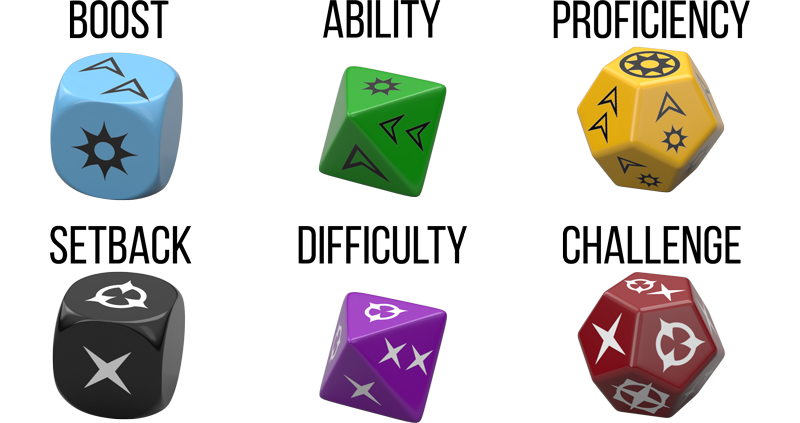
Dice Info Key
| Ability Dice | Difficulty Dice | Proficiency Dice | Challenge Dice | Boost Dice | Setback Dice | Force Dice |
|---|---|---|---|---|---|---|
| 🟩 | 🟪 | 🟨 | 🟥 | 🔵 | ⚫ | ⚪ |
| Adds basic success potential. | Increases difficulty. | Enhances ability, more success. | Adds failure, challenge. | Gives bonuses, benefits. | Introduces complications, hindrances. | Taps into Force powers. |
Building the dice pool
Please ask for help if you need it
Please don't hesitate to ask questions, I will be happy to answer any questions you might have! Unlike the D20 system, this is new, so we're all learing 
Assembling the dice pool in the Star Wars Roleplaying Game is a critical step that directly influences the outcomes of players' actions during gameplay. This process begins by identifying the task at hand and determining the relevant skill and characteristic associated with it. Players first gather a number of Ability dice equivalent to the higher value between the relevant skill level and the associated characteristic level. If the skill level is higher, the dice pool starts with as many Ability dice as the skill level; if the characteristic level is higher, the dice pool includes dice equal to that number. Following this, the player upgrades a number of these Ability dice to Proficiency dice. The number of dice upgraded equals the lower value between the skill and the characteristic. This upgrading reflects the combined effect of a character's natural talent and trained expertise. The resulting dice pool, consisting of both Ability and Proficiency dice, represents the player's total potential for success in the proposed action, ready to be rolled to determine the outcome.
flowchart TD
    A[Step 1: Get Dice] --> B[Step 2: Determine which is higher]
    B --> C{Characters Skill Level or Characteristic Level?}
    C -- Is Characters Skill Level Higher --> D[Add X ability 🟩 dice equal to Skill Level]
    C -- Is Characters Characteristic Level Higher --> E[Add X ability 🟩 dice equal to Characteristic Level]
    D --> F[Step 3: Upgrade Dice]
    E --> F
    F --> G[Upgrade a number of ability dice to proficiency🟨 dice equal to the lower value of Skill or Characteristic Level in step 2]
    G --> H[Proceed with Game Play]
Boost and Setback Dice
Boost and Setback dice are additional elements in the Star Wars Roleplaying Game that modify the dice pool to reflect external factors affecting a character's actions. These dice add a layer of complexity and realism to gameplay by accounting for advantageous or challenging conditions that are not directly tied to a character's inherent skills or characteristics.
Boost Dice (Blue Dice): These are added to the dice pool when a character has an advantage or favorable condition that could improve the outcome of their action. Common reasons to add Boost dice include having assistance from another character, using superior equipment, having a tactical advantage, or other situational benefits. Boost Dice increase the likelihood of success by providing additional success and advantage symbols.
Setback Dice (Black Dice): Conversely, Setback dice are introduced when there are complications or hindrances that make a task more difficult. These might include environmental obstacles, injuries, enemy tactics, poor visibility, or any other detrimental factors. Setback Dice introduce failure and threat symbols to the roll, increasing the chances that the action will not go as planned.
Both types of dice are crucial for game balance and depth, influencing the outcome of actions in ways that reflect the dynamic and often unpredictable nature of the narrative. They help to create a more engaging and strategic gameplay experience, where players must consider not only their characters' abilities but also how external factors might impact their success or failure.
interpreting the Dice
Interpreting the results of a dice roll in the Star Wars Roleplaying Game involves analyzing the symbols that appear on the dice once rolled. The dice used in this game are unique, with each type featuring a mix of symbols that indicate different outcomes:
Success (✓) and Failure (✗) Symbols: These determine the basic outcome of the action. Success symbols indicate a positive result, while failure symbols negate successes. If the number of success symbols exceeds the number of failure symbols, the action is successful. Otherwise, it fails.
Advantage (⨁) and Threat (⨂) Symbols: These add nuance to the roll's outcome. Advantages can provide additional beneficial effects even if the roll fails, such as gaining a tactical position or creating opportunities for allies. Threats represent minor setbacks or complications that occur regardless of whether the action succeeds or fails, like dropping an item or experiencing a momentary disadvantage.
Triumph (☆) and Despair (⛝) Symbols: These are special symbols that signify significant outcomes. A Triumph symbol indicates a major success or a critical positive event that has a considerable impact on the scene, often beyond the immediate success of the action. It can also trigger special abilities or critical effects. Despair represents a significant negative turn, introducing substantial complications or dramatic twists. Importantly, Triumph and Despair count as success and failure symbols, respectively, but also carry additional effects.
steps to interpret a roll:
Count Success and Failure Symbols: First, tally the number of each. Subtract failures from successes to see if the action overall succeeds or fails.
Evaluate Advantages and Threats: Next, assess the number of advantages versus threats. The difference can grant additional positive effects (if more advantages) or cause complications (if more threats).
Consider Triumph and Despair: Note any Triumph or Despair symbols. Even if an action fails, a Triumph can still bring a significant positive result in the narrative. Conversely, a Despair can introduce major obstacles or setbacks, even in the case of a successful action.
flowchart TB
    A[Start: Roll Dice] --> B{Count Success & Failure Symbols}
    B --> C[Calculate Roll Totals]
    C --> D{Total Success Symbols Greater Than Failures?}
    D -- Yes --> E[Action Succeeds]
    D -- No --> F[Action Fails]
    B --> G{Count Advantage & Threat Symbols}
    G --> H[Calculate Total Advantage & Threat]
    H --> I{Total Advantage Symbols Greater Than Threat?}
    I -- Yes --> J[Positive Effects Occur]
    I -- No --> K[Negative Effects Occur]
    B --> L{Check for Triumph & Despair}
    L --> M[Triumph?]
    M -- Yes --> N[Major Positive Impact]
    M -- No --> O[No Major Impact]
    L --> P[Despair?]
    P -- Yes --> Q[Major Negative Impact]
    P -- No --> R[No Major Impact]
    E --> S[End Interpretation]
    F --> S
    J --> S
    K --> S
    N --> S
    Q --> S